

How to Calculate High Pay for EB-1 Cases
How to Calculate High Pay for EB-1 Cases
Skyrocket Your EB-1 Petition with High Salary Proof
Welcome to our dedicated EB-1 educational series! We are your premier guide to successfully proving top 10% earnings for a winning employment-based Green Card application. At the Law Offices of Chris M. Ingram, we know that demonstrating extraordinary ability requires meticulous evidence, and verifying a high salary is often one of the strongest criteria you can present. Let’s dive into how you can effectively calculate and prove your elite compensation.
Master the EB-1 High Salary Criteria Now
Are you struggling to verify that your high pay actually meets the government’s strict standards? According to the core immigration statute INA § 203(b)(1)(A), you must definitively show that your salary exceeds the 90th percentile for your specific profession. To do this accurately, immigration officers expect you to use trusted, official government data. We are here to simplify this complex process for you!
NOTE: As you read through this guide, please open a separate browser tab so you can follow along with the actual website we reference. Since government web pages are periodically updated, accessing the live site rather than relying on static screenshots will help ensure you are viewing the most accurate and up-to-date salary information.
Step 1: Initiating Your Occupation Search
Example 1: Once you arrive at the O*NET Online homepage, there is an “Occupation Keyword Search” field where you can search for almost any mainstream occupation.
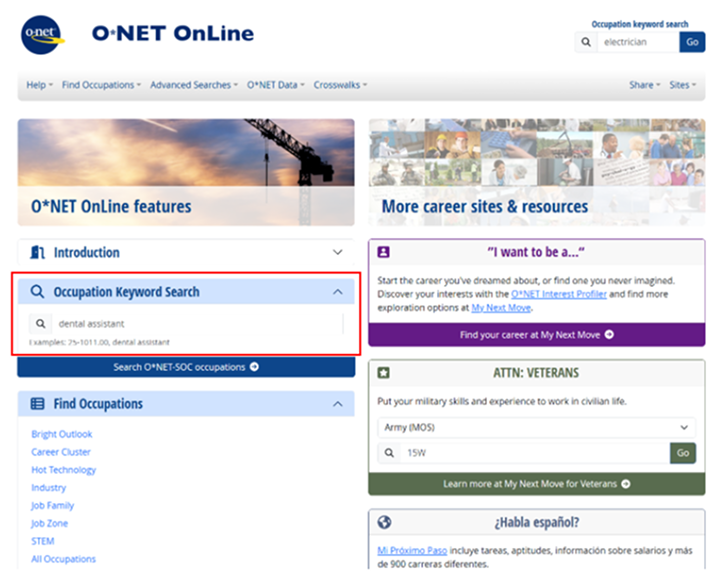
For this example, search for “Computer Systems Analyst.” Note the specific SOC (Standard Occupational Classification) code: 15-1211.00. This is a standard identifier used by the Bureau of Labor Statistics (BLS) and on many official government forms. You must use this SOC code to properly cross-reference salary data and other official resources.
Because internal corporate job titles vary wildly by company, you should focus strictly on the underlying occupation. Confirm the right SOC, and base your entire salary analysis on that framework. For this example, our client’s occupation is officially a Computer Systems Analyst (SOC 15-1211.00).
Next, scroll down the page to the “Job Zone” section. Review the Education, Job Training, and the SVP (Specific Vocational Preparation) Range to fully understand the preparation requirements.
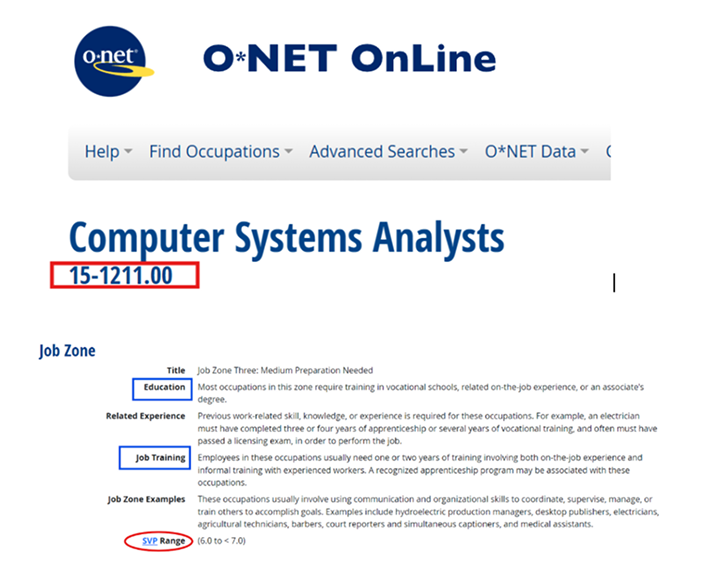
Use the “Job Training” section to see if the role typically needs a formal Bachelor’s Degree (BA) or substantial hands-on experience. The Computer Systems Analyst profile shows approximately 1 to 2 years, implying lighter professional preparation.
The SVP reflects the actual skill level required. You generally want to aim for an SVP of 7 to 8 or higher for BA-level roles; here it is 6.0 to less than 7.0, which falls just below that elite bar. Furthermore, the “Education” section outlines typical schooling (Associate’s ≈ 2 years; Bachelor’s = 4 years, with common transfers).
It is vital to remember that for the EB-1 Green Card category, lacking a specific required degree isn’t totally decisive; your extraordinary ability can legally outweigh it.
Step 2: Finding a Stronger Match with Financial Managers
Example 2: Let’s look at a “Financial Manager,” which maps to SOC 11-3031.00. My take: use an SVP of 7 to 8+ combined with a BA or extensive experience as a quick initial filter, then confirm the details with the training and education data.

If we scroll down to the “Job Zone” section for this new role, and first look at the “Education” section, we can clearly see that Financial Managers typically require a four-year bachelor’s degree.
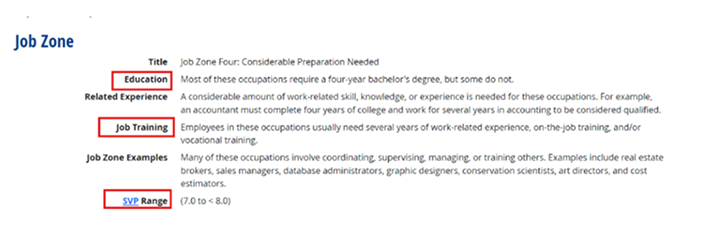
O*NET lists the typical years of training required to become established in this career. Financial Managers show an SVP of 7 to 8 (which indicates high professional skill; >8 is the highest).
Use O*NET as a starting point for your occupation research. Then, you must check if your specific pay lands in the top 10% (the 90th percentile or above) under the “Wages & Employment Trends” section, which pulls live BLS data.
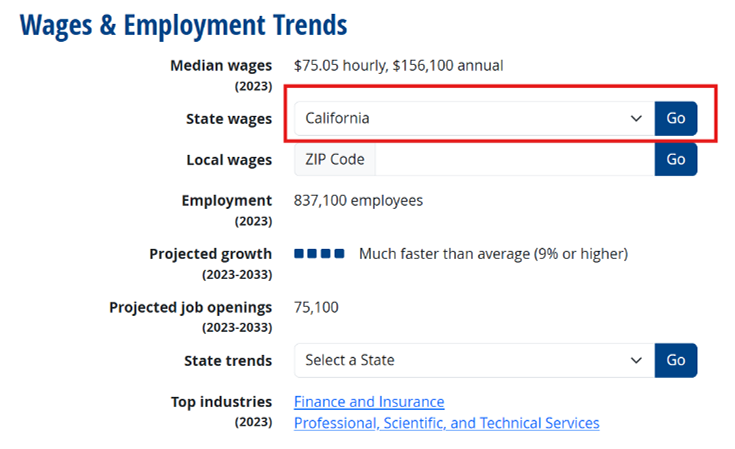
To find out what the range of salaries is for your specific geographic location, click on the ‘Select a State’ drop-down menu.
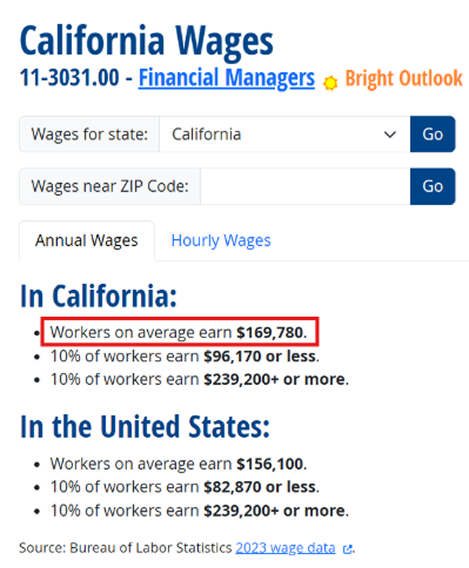
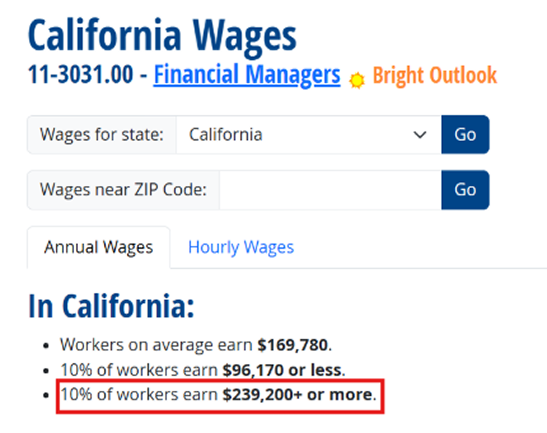
In this case, we have selected California. The data reveals that the median wage for a Financial Manager in California is $169,780. However, for strict EB-1 purposes, you will realistically need to earn $239,200 or more to successfully qualify in this category, as this is the baseline amount those in the top 10% are currently able to command in the open market.
(It is highly worth noting that many of our incredible EB-1 candidates find their overall earning potential substantially increases once they secure their permanent green cards and are finally able to compete properly in the open U.S. market!)
Compensation and Role Matching Strategies
When analyzing your income, remember that senior roles often pay a base salary plus an annual bonus. These bonuses absolutely count toward your EB-1 petition if they are clearly shown on official earnings documents (e.g., your W-2 tax forms).
Furthermore, you can include corporate perks and equity. We strongly advise having an accountant confirm your total compensation. This should include stock options or RSUs with their current market value, even if they are vesting at a later date. If your base salary plus bonus is at or above the 90th percentile, this category is incredibly strong for your case.
When researching, always choose a specific occupation that genuinely fits your daily duties (e.g., Software Developer, Accountant, Fashion Model) and avoid generic titles like “Chief Executive” unless that is entirely accurate.
Build Your EB-1 Success Path
Our vast legal expertise guides you safely through O*NET data and beyond, safely securing your high salary proof for U.S. Citizenship and Immigration Services (USCIS) approval. By utilizing our robust [Immigration Education] resources, you can build an undeniable case.
Are you ready to shine on the global stage? Contact us for a free consultation today, and let’s secure your EB-1 Green Card triumph!
Comments on this entry are closed.